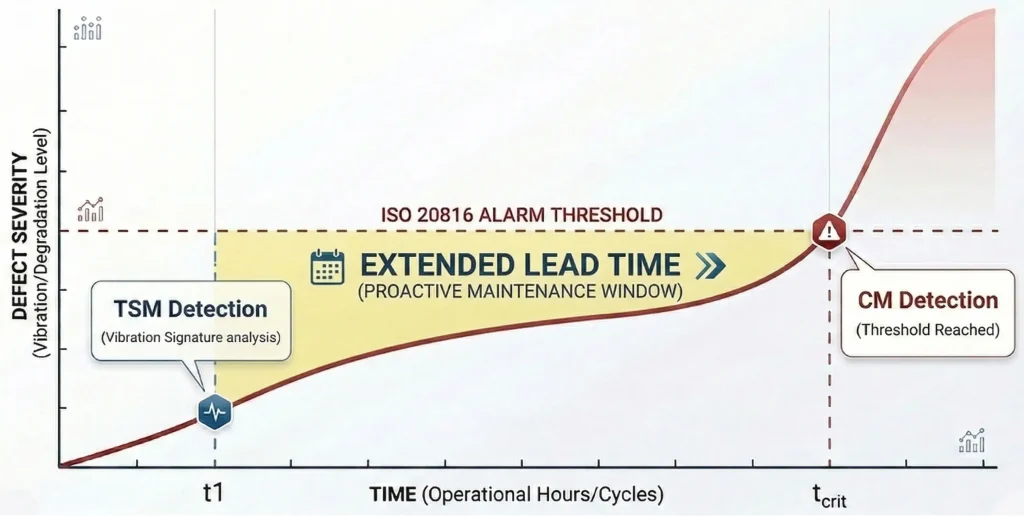
The fundamental difference between these two approaches is simple: condition monitoring tells operators and engineers that a machine is changing by tracking vibration trends, whereas technical state monitoring tells them why it is changing by automatically diagnosing the defect and issuing a maintenance prescription. While standard methods alert the control room only when vibration hits a danger limit, technical state monitoring identifies the root cause for reliability engineers weeks earlier, often while the machine still appears healthy.
Understanding these distinctions is the key for plant personnel to move from reactive firefighting to 99% plant availability. In the following guide, we break down the critical differences in logic, accuracy, and financial ROI that every GCC reliability manager and engineer must master to achieve world-class asset integrity.
Traditional Condition Monitoring (CM) for Rotating Equipment
Condition monitoring serves as the foundational layer of predictive maintenance for machinery. It involves the continuous or periodic acquisition of physical signals to enable reliability engineers to track how a machine’s behavior changes over time.
- The Process: Deployment of sensors to track vibration levels, bearing temperatures, and RPM.
- The Objective: Helping personnel identify when a trend – such as a rise in vibration velocity – deviates from a known healthy baseline.
- The Methodology: Most conventional systems rely on “threshold-based” alerts. Alarms are triggered for the staff only when parameters reach a pre-set high limit, often based on standard ISO 20816 charts.
The primary limitation for maintenance teams is that by the time a vibration threshold is breached, internal mechanical damage is usually already present. In this framework, the system detects the failure after it has begun, rather than identifying the specific defect for the engineer.
Advanced Technical State Monitoring (TSM)
Technical state monitoring represents the next step in the evolution of machinery monitoring. This methodology, implemented through the COMPACS® system, moves beyond raw data collection to provide automated expert diagnostics for the entire plant team.
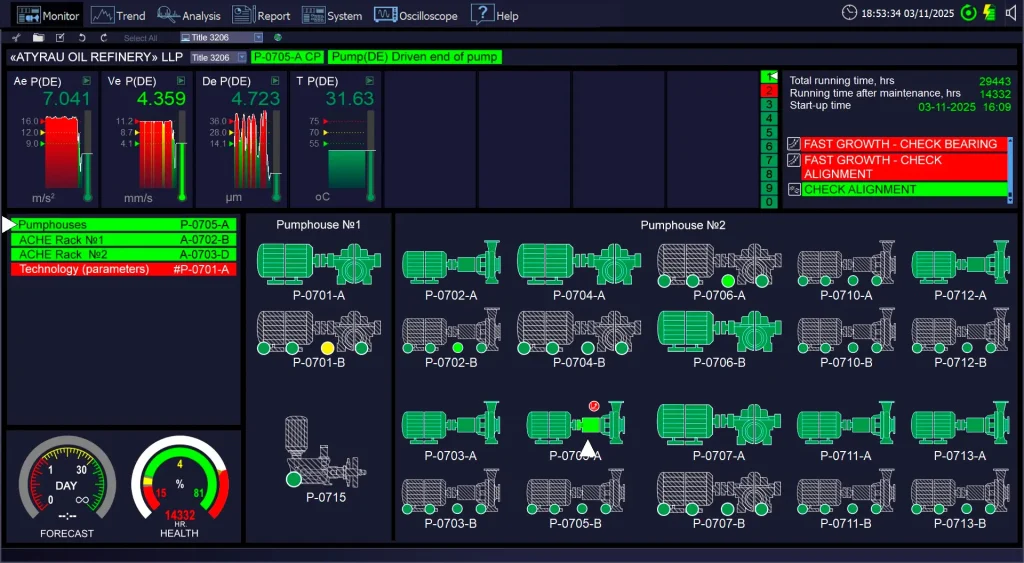
Unlike standard approaches, TSM focuses on the actual “technical state” of the rotating equipment. The system identifies specific defects automatically. This supports operators who may not be experts in signal analysis. For reliability engineers, it defines the exact stage of defect development. It then provides a direct maintenance instruction for the operator. This removes the guesswork often associated with manual vibration analysis.
The Four-Stage TSM Workflow for Rotating Equipment:
Measurement
Capturing high-resolution, wide-bandwidth analog signals across the entire frequency range of the machine.
Identification
Automatic detection of the particular defect (e.g., rotor imbalance, shaft misalignment, or inner race bearing wear).
Staging
Determining exactly how far the defect has progressed toward a potential failure.
Prescription
Generating a clear, actionable prescription for the maintenance team, such as “Check balance” or “Check bearing (outer ring).” Check the list of all defects detected by the COMPACS system.
The Three-Tier Classification of Technical State:
- Acceptable (Green): The machine is healthy; no intervention required by the crew.
- Action Required (Yellow): An early-stage defect is identified. Personnel must plan maintenance to prevent equipment degradation.
- Unacceptable (Red): Critical risk of catastrophic failure; immediate shutdown or load reduction is required by the operator to protect the asset.
Explore All the Benefits of The Technical State Monitoring
Discover how real-time equipment diagnostics with AI-prescriptions can increase uptime and reduce maintenance costs.
Early Diagnostics vs. Threshold Alerts
Conventional machinery monitoring depends on overall energy levels. However, operators of centrifugal pumps, compressors, or fin fans may face a serious internal defect, like a localized bearing crack, while the overall vibration velocity remains within “normal” limits on a standard meter.
The COMPACS® system focuses on early diagnostics. By identifying the unique frequency “fingerprint” of a fault, the system detects degradation for the reliability engineer weeks or months before the overall vibration level increases. This allows the maintenance team to schedule repairs during planned shutdowns, protecting the facility from expensive emergency downtime.

System Architecture for Rotating Equipment
Monitoring high-speed rotating equipment requires hardware that can handle complex signal processing in real-time for plant personnel.
- Wide-Bandwidth Sensors: Standard sensors often miss high-frequency stress waves. Technical state monitoring requires sensors with bandwidth up to 11 kHz to detect the earliest signs of friction or micro-cracking in pumps, air blowers, and smoke exhausters.
- Revolution-by-Revolution Analysis: TSM requires the system to analyze every shaft revolution in real-time. This ensures that transient defects or phase shifts are caught immediately by the monitoring team.
- Digital Integration: Diagnostic data from the COMPACS® system feeds directly into plant-wide management platforms, making the technical state of every rotating asset visible to both operators in the control room and managers in the head office. Moreover, everyone involved in plant reliability can access this information.
Let’s Discuss Your Reliability Goals
Discover how real-time equipment monitoring with AI-prescriptions can increase uptime and reduce maintenance costs.
Alignment with Rotating Machinery Standards (API & ISO)
Reliability engineers in the GCC must comply with strict international standards for rotating equipment. Technical state monitoring is designed to complement and exceed these requirements for industrial safety.
- API 670 & 617: While these standards set the minimum requirements for machinery protection and automatic trips, the COMPACS® system provides the diagnostic “why” behind every event, preventing operators from performing “blind” restarts after an emergency shutdown.
- ISO 20816: Conventional systems use ISO velocity charts to set generic limits. TSM uses these as a baseline but adds physics-based AI diagnostics for engineers to find defects that exist well below the “danger” levels specified in the standard.
Financial Performance: Condition Monitoring vs. TSM
From a management perspective, moving to technical state monitoring offers a measurable improvement in both OPEX and CAPEX.
| Financial Metric | Condition Monitoring (Conventional) | Technical State Monitoring (TSM) |
|---|---|---|
| Repair Costs | High (secondary damage is common). | Low (isolated, early-stage fix). |
| Downtime | Unplanned and emergency-driven. | Planned and optimized. |
| Asset Life | Reduced by late-stage mechanical stress. | Maximized via “Green State” operation. |
| Labor Efficiency | Needs specialists for manual data review. | Automated expert diagnostics. |
| Operational Risk | High (risk of late detection). | Low (100x reduction in failure risk). |
Implementation typically allows managers to achieve a 30% reduction in maintenance OPEX by preventing unnecessary part replacements and avoiding the high cost of unplanned outages.
Technical Comparison Table
| Feature | Condition Monitoring (CM) | Technical State Monitoring (TSM) |
|---|---|---|
| Logic | Threshold-based (Often too late). | Early diagnostics (Proactive). |
| Analysis | Manual review of spectra/waveforms. | Fully automated via COMPACS®. |
| Output | Generic alarm or alert. | Technical Prescription. |
| Decision Support | Human-dependent (Subjective). | System-driven (Objective). |
| Diagnosis Speed | Delayed (needs engineering review). | Instantaneous (Real-time). |
| Accuracy | Varies by analyst skill. | Consistently high (97%–99%). |
Case Studies: Rotating Assets in Action
Crude Oil Feed Pump (Bearing Defect)
- Conventional CM: Overall vibration recorded at 2.2 mm/s (within Normal limits). The standard system did not trigger an alert for the pump operator.
- Technical State Monitoring: The COMPACS® system identified a high-frequency signature of inner race wear for the reliability engineer. The technical state was classified as Action Required.
- Prescription: “CHECK BEARING”. The replacement was planned and executed before a pump failure occurred.
Reciprocating Gas Compressor (Valve Failure)
- Condition Monitoring: Pressure and temperature readings remained stable for the operator. No vibration alarms were active.
- Technical State Monitoring: COMPACS® analyzed cyclic pressure waveforms and detected a leakage pattern on cylinder #1.
- Prescription: “CHECK SECTION VALVES”. The defect was fixed during a scheduled stop, preventing an unplanned shutdown and potential fire.
All You Need to Know About The COMPACS® System
Discover how technical state monitoring with AI-prescriptions can boost uptime and lower maintenance costs.
Frequently Asked Questions (FAQ)
Standard systems only alert you when the machine casing is already shaking. Technical state monitoring uses physics-based AI to identify the root cause while the machine continues to run smoothly. This allows maintenance teams to act proactively on pumps, compressors, and fin fans before secondary damage occurs.
Conventional vibration energy is extremely low in slow-moving parts like smoke exhausters or large air blowers, making standard thresholds ineffective. The COMPACS® system uses wide-bandwidth analysis to detect defect “fingerprints” that standard tools simply cannot see in low-speed applications. However, monitoring machinery with RPMs below 100 is a challenging task even for the COMPACS system.
Many predictive maintenance tools struggle with transient states. Because the COMPACS® system incorporates a physics-based AI and monitors every shaft revolution, it accurately distinguishes between normal transient behavior and actual mechanical defects. This significantly reduces false alarms in the control room during critical maneuvers.
The key is preventing mechanical stress by maintaining an “Acceptable” state. By performing only targeted repairs based on automated prescriptions, maintenance teams avoid unnecessary work and ensure that equipment like compressors and pumps operate within their design limits for longer periods.
A fault alarm is a simple warning that an operational limit has been breached and the machine is at risk. A technical state diagnosis is a complete health category: Acceptable, Action Required, or Unacceptable, that provides plant personnel with a specific solution, known as a prescription.
Conclusion
For modern oil and gas operations, simply collecting vibration data is no longer enough. While condition monitoring provides the data, the real-time diagnostic COMPACS® system provides the solution. By focusing on the technical state of rotating equipment such as compressors, pumps, and fin fans, GCC facilities ensure that operators and reliability engineers achieve 99% availability, lower maintenance costs, and the highest standards of industrial safety.
Ready to Increase Uptime by 6-8 Times?
Book Your Strategy Call Now
Explore Our Case Studies
Case Study: Condition-Based Maintenance Of an Oil Pump
06/28/2024
In this case study, we present a condition-based maintenance case using the real-time diagnostic COMPACS system. Pump Monitoring In the...
Read More
The COMPACS® System in Action: The Bottleneck's Eliminating Case
06/21/2024
We will present bottlenecks eliminating case study on how to remove bottlenecks. Here, you see two trends of different vibration...
Read More
Case Study: The Heat Exchanger Real-time Health Monitoring
09/19/2023
The Heat Exchanger Real Time Health Monitoring Let us consider an example of a heat exchanger and a feedstock recuperator...
Read More