Executive Summary
- The Goal: Prevent sudden machinery failures to ensure continuous, safe production in high-demand facilities.
- The Challenge: Traditional condition monitoring systems alert operators only after equipment damage reaches a critical stage.
- The Solution: Real-time digital reliability uses physics-based AI to detect early signs of mechanical wear automatically.
- The Impact: The COMPACS system provides 24/7 actionable prescriptions directly to operators, mitigating supply chain delays, enabling remote operations, and preventing costly unplanned shutdowns.
Redefining ROI: Maximum Capacity and Asset Survival
The industrial landscape in the Middle East is operating at maximum capacity. Historically, predictive maintenance focused on optimizing repair schedules to save routine costs. Today, across the GCC, Red Sea coast, and Oman, the priority is different.
The new standard for Return on Investment (ROI) is risk mitigation and asset preservation. With unpredictable global supply chains, facilities must ensure continuous production without relying on immediate part replacements.
Implementing 24/7 real-time machinery diagnostics transforms sudden equipment failures into predictable events. The Digital Reliability approach saves significant revenue by preventing costly unplanned shutdowns in critical downstream assets.

The Core Challenges for Processing Facilities
Refineries and export terminals currently face high mechanical stress. Plant leadership must address three main challenges:
Supply Chain Delays
Importing replacement parts for major pumps, compressors, or turbines can take months. A single component failure can cause prolonged downtime.
Remote and Unmanned Operations
Modern safety protocols require fewer personnel in dangerous areas. Facilities need automated monitoring to replace manual data collection, enabling secure operations with streamlined teams.
Preventing Secondary Incidents
High-stress operations increase the risk of mechanical breakdowns escalating into severe safety or environmental incidents. Predictive analytics are required to stop manageable issues from becoming localized emergencies.
The Digital Reliability Solution: Real-Time Diagnostics
To secure operational continuity, facilities need true early diagnostics. A standard Condition Monitoring System typically triggers alarms during the exponential wear stage, when critical damage has already occurred.
The COMPACS system utilizes physics-based Artificial Intelligence to identify destructive forces during the non-linear wear stage, long before a defect evolves.

By continuously analyzing up to 80 different parameters per machine, including vibration acceleration, velocity, displacement, temperature, and pressure, the COMPACS system provides true early-warning capabilities. For example, a small cantilever pump can be reliably monitored using just one piezoelectric accelerometer, identifying over 95% of rotating equipment defects.
Explore All the Benefits of Automated Diagnostics
Discover how real-time diagnostics with physics-based AI prescriptions can prolong equipment lifespan and ensure maximum capacity.
Fully Automated Intelligence
Unlike conventional vibration analysis tools that require a specialized engineer, the COMPACS system delivers fully automated, unbiased prescriptions directly to the operators on duty.
This technical automation earned the COMPACS system the Hydrocarbon Processing Award for Best AR/VR/AI Technology.
As noted by the Head of Equipment Reliability at a major continuous-process plant:
“COMPACS’s fully automated diagnostics remove the need for manual data interpretation. It gives our teams immediate, actionable insights exactly when they need them.”
When operators address destructive forces during the early stages of degradation, they can dynamically adjust operational loads. This safely extends the equipment lifespan until supply chains allow for planned maintenance.
Agile Integration for Strategic Infrastructure
Regional mega-projects and high-capacity export terminals require immediate deployment.
The COMPACS system integrates smoothly with existing SCADA (Supervisory Control and Data Acquisition) and maintenance management networks without disrupting operations.
Because capital expenditure (CAPEX) budgets often require lengthy approvals, we offer flexible, OPEX-driven “System-as-a-Service” models. This allows plant directors to implement world-class monitoring quickly using standard operational funds.

Let’s Discuss a New Era of Operations in GCC
Discover how real-time equipment monitoring with early diagnostics supports new plant goals.
Comparing Maintenance Strategies
| Feature | Traditional Condition Monitoring | Digital Reliability (COMPACS) |
| Timing of Alert | Late (Critical damage stage) | Early (Initial wear stage) |
| Data Collection | Manual, route-based, or periodic | 24/7 continuous and automated |
| Analysis Required | Requires a vibration expert | Fully automated by AI |
| Actionable Output | Delivers raw data and alarms | Delivers clear maintenance prescriptions |
| Primary Goal | Minimize the impact of a failure | Prevent the failure entirely |
The SROMM Framework: Aligning Teams for Maximum Uptime
Implementing real-time diagnostics is only the first step. True asset resilience requires a structured flow of information throughout the entire organization. The COMPACS system supports the SROMM (Safe Resource-saving Operation and Maintenance of Machinery) methodology by establishing transparent, objective data loops.
As shown, the system links three critical levels: Operators receive immediate, focused diagnostic prescriptions to adjust processing modes, the Maintenance Team uses root cause analysis for timely, targeted actions rather than relying on arbitrary schedules, and Management gains full visibility into equipment health, maintenance quality, and operator performance. This interconnected approach ensures maximum plant uptime and significantly boosts profits by greatly reducing maintenance costs.

Frequently Asked Questions (FAQ)
The COMPACS system is an automated monitoring tool for industrial equipment. It tracks parameters like vibration, temperature, and pressure 24/7. It identifies defects early and sends clear instructions to operators to prevent breakdowns.
Physics-based AI is built on the scientific rules of mechanical wear. It identifies the specific physical forces causing damage. This allows the system to recognize over 95% of equipment defects with high precision, without needing a human expert to review the data.
Finding a defect early allows operators to change how the machine runs (such as adjusting the load). This prevents sudden failures, fires, or complete system shutdowns when repair parts are delayed.
ROI comes from extending equipment life and avoiding unplanned downtime. Stopping a single major failure in a continuous-process plant saves millions of dollars in lost production and reduces routine maintenance costs by up to 40%.
Technical Glossary of Digital Reliability
- Non-linear Wear – The earliest stage of machinery damage. Detecting defects here is the best way to prevent failures.
- Diagnostic Error – When a monitoring system fails to detect a problem or detects it too late to stop a breakdown.
- SROMM – Safe Resource-saving Operation and Maintenance of Machinery. A management strategy focused on high safety and maximum plant uptime.
Schedule a Technical Briefing on the Digital Reliability Strategy
Discover how the award-winning COMPACS system provides complete transparency into your machinery’s health and ensures operational continuity. Please use the calendar widget below to select a time for a technical discussion with our engineering team.
Explore Our Case Studies

Real-Time Pipeline Monitoring and Leak Detection with the COMPACS System
05/23/2025
Real-time Pipeline Monitoring Modern real-time pipeline monitoring solutions aim to prevent leaks before they escalate into disasters. As infrastructure ages...
Read More
The COMPACS® System in Action: Eliminating the Root Failure Cause of an Exhauster
03/26/2024
Exhauster Monitoring Success Story Embark on a journey of maintenance innovation as we unveil a groundbreaking case study showcasing the...
Read More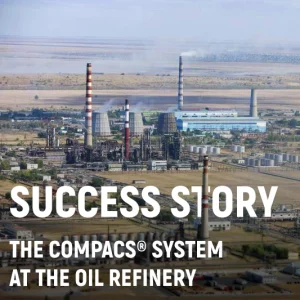
Asset Reliability Management Based On Digital Technologies & AI
03/13/2024
Industrial safety is vital in ensuring the profitability of oil-refining and petrochemical industries. A high level of industrial safety in...
Read More