Industrial pumps are vital for operations in industries like oil and gas, where equipment reliability and efficiency are non-negotiable. Unplanned downtimes or pump failures can result in significant financial and operational setbacks. In this pump monitoring case, we dive into a real-world example where the real-time diagnostic COMPACS system not only detected the root causes of pump failures but also enabled a swift resolution, ultimately extending the equipment’s residual lifespan and improving overall performance.
You can watch the video from YouTube or keep reading the Pump Monitoring Case article.
The Challenge: Persistent Failures in a Multi-Stage Pump
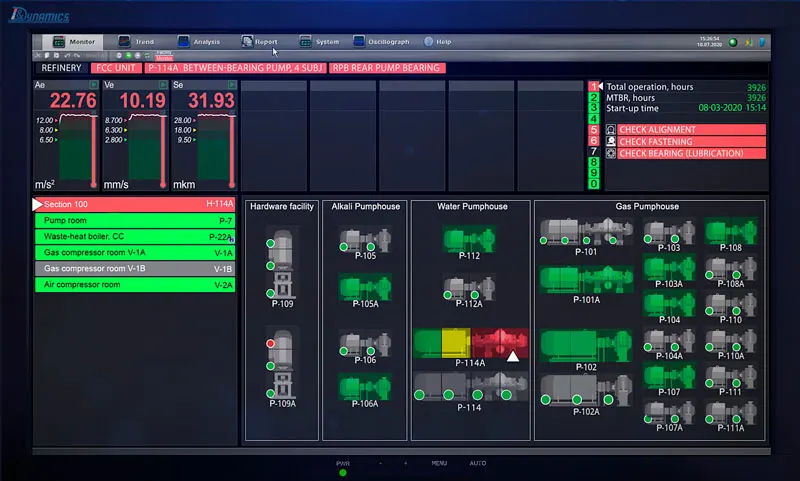
A between-bearing multi-stage pump equipped with the equipment monitoring system faced recurring operational issues following routine maintenance. Despite efforts such as multiple alignment corrections and balancing adjustments, the pump’s condition remained unsatisfactory, and the COMPACS system kept highlighting the machine’s unacceptable state with the following prescriptions:
Check Fastening
Check Misalignment
Check Bearing

Diagnostic Process: Insights from the Pump Monitoring System
The real-time diagnostic COMPACS system employs advanced vibration and current analysis to monitor pump health continuously. In this case, the system revealed:
- Misalignment Detection
The vibration velocity and displacement spectra exhibited a significant peak at the 2x frequency. This pattern indicated misalignment, which caused uneven load distribution and heightened vibration. - Bearing Defects Identification
The vibration spectrum showed abnormalities linked to bearing issues, such as wear or deformation, which, if left unaddressed, could result in significant consequences and costly maintenance. - Fastening and Assembly Issues
The absence of broadband vibrations and multiple noise components indicated potential problems with the pump’s assembly or mounting. This finding was later confirmed during disassembly.

Explore Predictive Maintenance with the COMPACS System’s Brochures
Learn how Analysis Mode and our real-time prescriptions can transform your approach to equipment maintenance. Dive into customized analytics and take control of your machinery condition.
Root Cause Analysis: Findings Upon Inspection
The maintenance team, guided by the COMPACS system’s prescriptions, performed an in-depth inspection and found the next malfunctions which are significantly affected the pump’s condition and performance:
- Severely deformed coupling.
- Displaced half-coupling pin sockets.
- Misaligned frame plane.
- Crack in the pump’s seal ring.

Actions Based on Pump Monitoring System Insights
Based on the diagnostics from the monitoring system, the maintenance team:
- Realigned pump components and bearing brackets.
- Repaired and reinstalled the coupling.
- Adjusted the frame alignment to eliminate stress.
- Replaced the damaged seal ring.
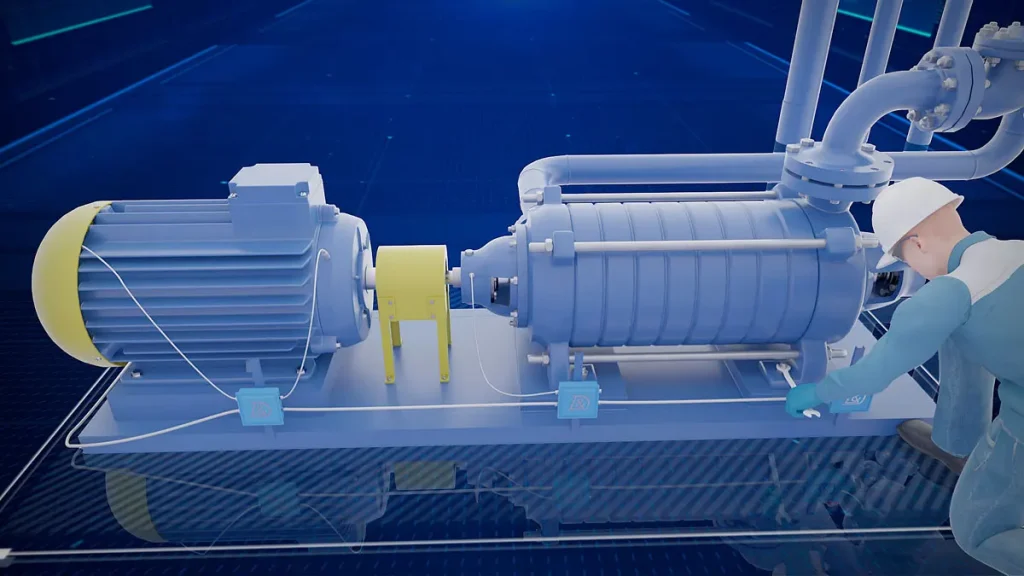
After reassembly, the pump vibration monitoring system confirmed that the pump operated efficiently, achieving optimal performance and an extended lifespan. This pump monitoring case is a prime example of how the real-time diagnostic systems can help identify root causes, eliminate sudden equipment failures, significantly increase equipment uptime, and dramatically reduce maintenance efforts and costs.
Top 6 Pump Failures Identified by the COMPACS System
The real-time diagnostic system detects and diagnoses the emergence of a wide range of failures in rotating equipment. Below are the top six failures it can identify, ranked from least to most frequent:
| Failure Type | Description | Impact |
|---|---|---|
| Fastening Issues | Improper fastening of pump components. | Causes instability and vibration. |
| Cavitation | Formation of vapor bubbles in the pump. | Leads to efficiency losses and impeller erosion. |
| Rotor Eccentricity | Off-center rotation of the rotor. | Increases vibration and accelerates wear. |
| Imbalance | Uneven mass distribution in rotating parts. | Causes excessive vibration and noise. |
| Misalignment | Incorrect alignment between shafts. | Results in uneven load distribution. |
| Bearing Defects | Faults such as pitting or lack of lubrication. | Leads to overheating and breakdowns. |
All these defects and failures can lead to catastrophic equipment degradation and a significant increase in maintenance expenses or even accidents. Pump monitoring and vibration diagnostics are critical for predictive maintenance in oil and gas, mining, petrochemical, and other major industries. The COMPACS system identifies defects at the very beginning before they degrade the equipment. The monitoring system incorporates advanced techniques to ensure optimal pump performance.
Benefits of Pump Monitoring System
- Proactive Problem Detection: Early identification of issues reduces downtime.
- Cost-Effective Maintenance: Minimizes repair costs and extends equipment lifespan.
- Enhanced Safety: Detects a wide list of faults, including the most dangerous, to ensure reliable operations.
- Data-Driven Decision Making: Streamlines workflows and improves resource allocation.
Conclusion: The COMPACS System as a Game-Changer
This case study demonstrates how the pump vibration monitoring system transforms maintenance at industrial facilities. By detecting root causes of failure, the system empowers teams to implement effective solutions quickly, ensuring maximum operational efficiency and reliability. Adopting advanced diagnostic tools like COMPACS is essential for maintaining competitiveness and ensuring long-term success.
Explore Our Case Studies

The COMPACS® System in Action: Eliminating the Root Failure Cause of an Exhauster
03/26/2024
Exhauster Monitoring Success Story Embark on a journey of maintenance innovation as we unveil a groundbreaking case study showcasing the...
Read More
Case Study: The Heat Exchanger Real-time Health Monitoring
09/19/2023
The Heat Exchanger Real Time Health Monitoring Let us consider an example of a heat exchanger and a feedstock recuperator...
Read More
The COMPACS® System in Action: Monitoring of a Fin Fan in a Crude Distillation Unit
12/08/2023
Fin Fan in a Crude Distillation Unit Monitoring Case The Real-time Diagnostic COMPACS® System monitors one of the most important...
Read More