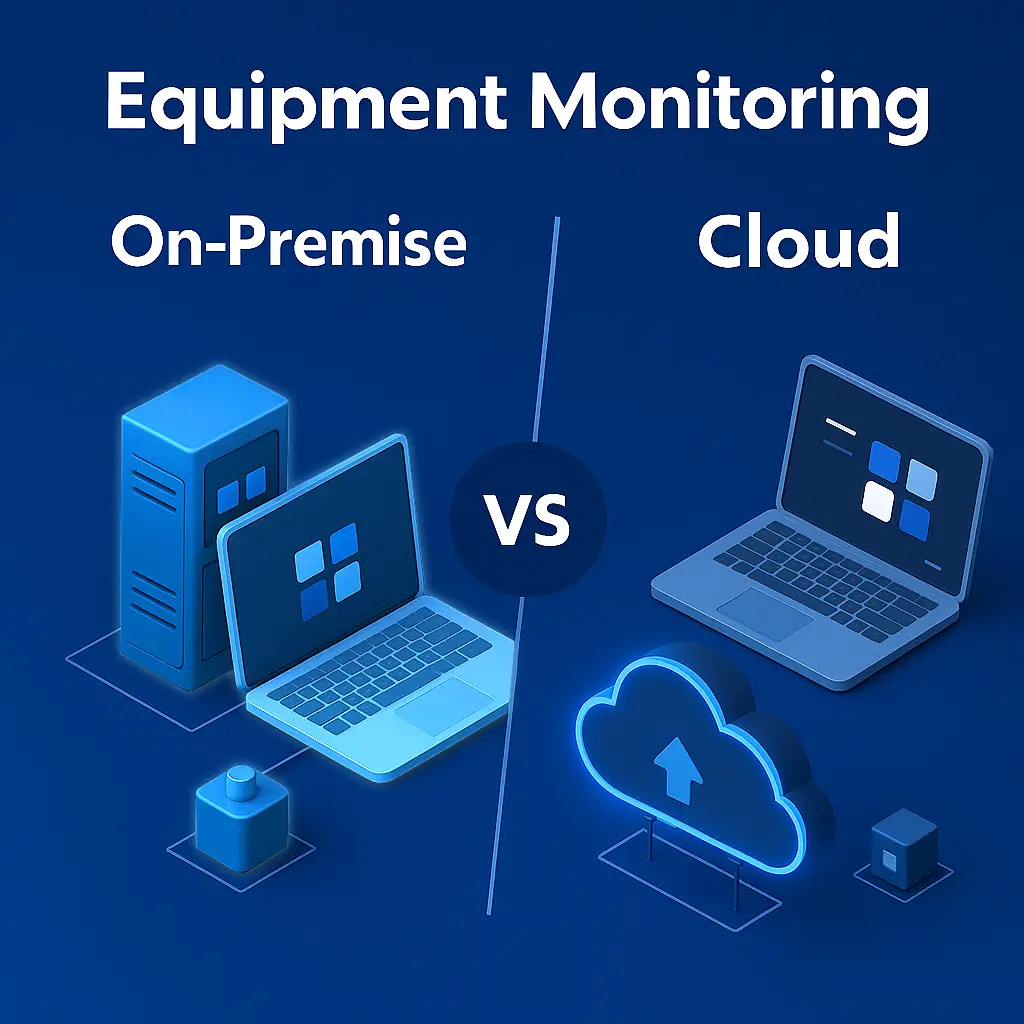
What if your most expensive machine could warn you before it fails? In today’s industrial landscape, this is not just possible, it’s expected. Predictive maintenance and condition/state monitoring are transforming asset reliability across critical sectors. Let’s compare cloud VS on-premises equipment monitoring systems.
This article explores the strategic implications of choosing between on-premises and cloud-based deployment models for real-time equipment monitoring systems. It focuses on high-stakes industries such as downstream oil and gas, petrochemicals, mining, energy, and utilities, where performance, data control, and security are mission-critical. We compare both approaches based on operational efficiency, cost structure, compliance, and real-time responsiveness.
Predictive maintenance and condition monitoring solutions are crucial in modern industrial asset management. These systems help detect faults before they cause equipment failures. Choosing between on-premises and cloud-based deployments is a strategic decision that affects performance, data control, and long-term costs. This article compares both models, providing practical insights for managers and engineers.
Understanding Deployment Models
On-premises systems are installed and operated within the facility. All data, processing, and control remain inside the organization’s network. This model offers complete control over system behavior and data security. Cloud-based systems run on remote servers, typically managed by external vendors. Data from the plant is transmitted over the internet for analysis, with results accessed through web interfaces.
Each deployment type has advantages and disadvantages. Let’s explore their features in more detail.
Advantages of On-Premises Systems
On-premises real-time equipment diagnostic systems are an excellent option for environments where speed, privacy, and regulatory control are critical.
Key benefits:
- Easier integration with existing SCADA and DCS systems
- Full ownership of data and infrastructure
- Minimal reliance on external networks
- Instant real-time response and analysis on site
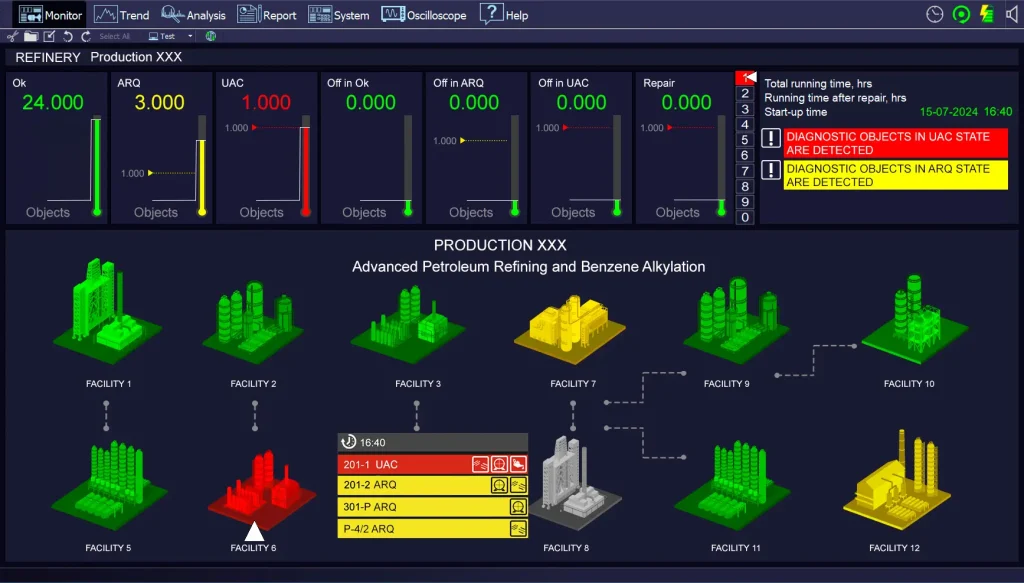
Many industrial facilities deploy local systems for real-time equipment monitoring to protect critical assets. While traditional setups often rely on simple, expert-defined rules and thresholds, modern localized solutions are evolving. For example, the COMPACS® system utilizes a physics-based AI within an on-premises architecture. Unlike purely data-driven models that require thousands of historical failures to “learn,” physics-based algorithms rely on the fundamental laws of mechanics and vibro-diagnostics. This allows the system to identify early signs of defects and provide actionable prescriptions directly to on-site operators, without requiring a permanent connection to external data lakes.
On-premises systems are preferred when downtime has serious consequences and losses or when sensitive operational data must stay within the facility.
Disadvantages of On-Premises Systems
Despite their strengths, on-premises systems present several limitations:
- High upfront costs for servers, software, and infrastructure setup
- No access from locations outside the facility
- Rely on internal IT teams for system updates and technical support
- Complex and costly to scale across multiple sites or regions
- Slower adoption of software updates and new features
Let’s Talk About The Monitoring Systems
Discover how real-time monitoring with AI-prescriptions can increase uptime and reduce maintenance costs.
Advantages of Cloud-Based Systems
Cloud-based platforms are popular for scalable and centralized monitoring across multiple sites. They are particularly appealing to companies growing their digital operations.
Main advantages:
- Subscription-based pricing with low upfront costs
- Access from any location via web or mobile app
- Automatic software updates and feature enhancements are available with subscription
- Support for advanced analytics conducted by vibration and reliability subject matter experts
Where Cloud-based Solutions Work
Cloud monitoring allow centralized monitoring of multiple assets or facilities. They often include predictive algorithms that learn from large volumes of data. For organizations with multiple sites or limited IT staff, cloud deployment offers fast implementation and easier scaling. Teams across different locations can collaborate on maintenance strategies using shared dashboards.
Disadvantages of Cloud-Based Systems
Cloud solutions also come with their own set of drawbacks:
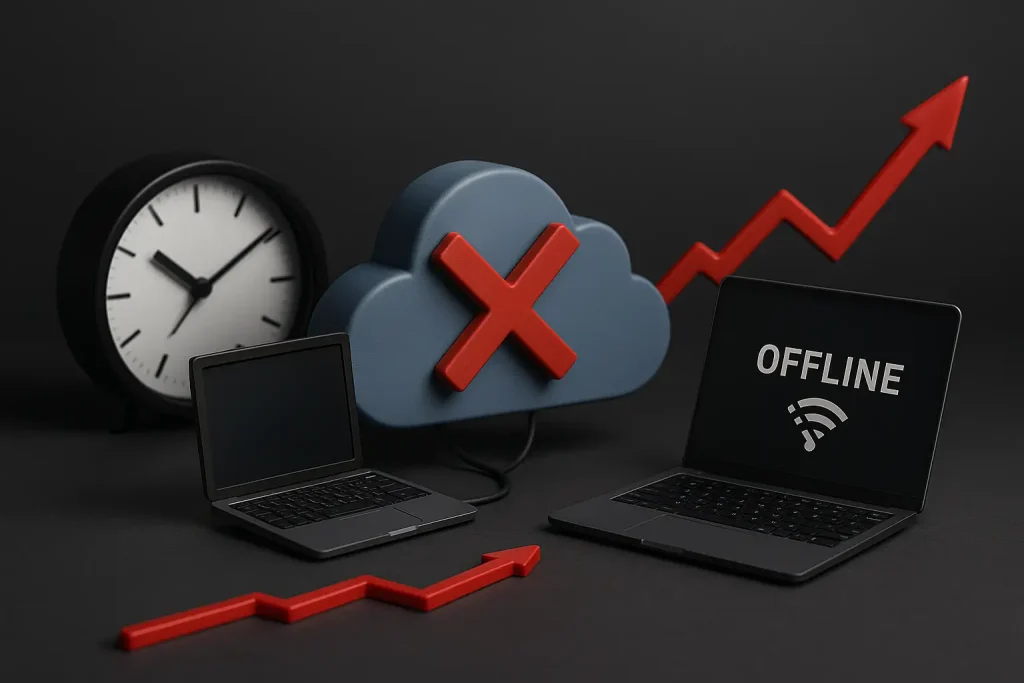
Latency in Mission-Critical Operations While edge computing helps buffer data, relying on cloud processing introduces inevitable network latency. For critical machinery like compressors, where emergency trips must occur in milliseconds, waiting for off-site analysis poses an unacceptable operational risk.
Data Sovereignty and Compliance Risks Sending sensitive telemetry data to offshore cloud servers often conflicts with stringent national cybersecurity regulations. In regions with strict data localization laws for critical infrastructure, maintaining compliance with remote cloud storage can be highly problematic.
Reliance on Continuous Connectivity Although local edge controllers can store data temporarily during brief outages, they are not a standalone solution. Long-term network disruptions will completely sever your access to real-time analytical capabilities, leaving critical assets unmonitored.
The “Cold Start” of Data-Driven AI: Standard cloud-based Machine Learning models require massive datasets of historical equipment failures to train effectively. In highly reliable facilities where critical assets rarely fail, gathering this data takes years, rendering the system under-optimized initially.
Vendor-Driven Platform Changes Cloud solutions force users onto standardized update schedules and platform modifications dictated by the provider. This lack of internal control over software versions can lead to unexpected interface changes, forced downtimes, or integration issues with existing workflows.
Comparison Table
| Feature | On-Premises | Cloud-Based |
|---|---|---|
| Feature | On-Premises | Cloud-Based |
| Deployment Location | Inside facility | Remote data centers |
| Data Control | Full internal control | Managed by vendor |
| Internet Dependency | None required | Required for real-time access |
| Upfront Investment | High (hardware, setup) | Low (subscription model) |
| Maintenance Responsibility | Internal IT team | Vendor-managed |
| Update Process | Manual | Automatic |
| Scalability | Limited by local resources | Highly scalable |
| Real-Time Processing | Immediate local response | May include delay |
| Compliance & Privacy | Easier for strict regulations | Requires vendor assurances |
| Long-Term Cost | Lower after setup | Ongoing subscription fees |
Use Cases For Cloud VS On-Premises Systems
- On-premises systems are best suited for remote or isolated locations, such as oil refineries or mines, where a reliable internet connection may be unavailable.
- Cloud-based platforms are most effective in distributed networks that require centralized data analysis across multiple sites.
- Hybrid approaches are increasingly popular, combining local processing with cloud-based analytics for strategic decision-making.
Bridging the Gap: On-Premises Security with a SaaS Business Model
The traditional barrier to on-premises systems has always been the high capital expenditure (CapEx) and IT burden. However, deployment models are shifting.
Solutions like the COMPACS system bridge this gap by offering on-premises physical deployment through a System-as-a-Service (OpEx) financial model.
- Architecturally, it operates entirely locally behind the plant’s firewalls, ensuring zero-latency diagnostics, immediate real-time response, and strict compliance with national data security regulations.
- Financially and Operationally, it is offered as a subscription. This shifts ownership toward predictable operational costs, removing the need for massive upfront investments. Expert support and system updates are managed through the service framework, alleviating the strain on internal IT teams.
This approach delivers the non-negotiable responsiveness and security of an on-premises system while mirroring the financial flexibility of the cloud.
Explore All The COMPACS® System’s Benefits
Discover how on-premises real-time monitoring with AI-prescriptions can increase uptime and reduce maintenance costs.
Common Questions About Cloud VS On-Premises Monitoring
Yes, modern cloud providers use strong encryption and access controls. However, for complete security, it is recommended to choose on-premises systems to maintain full control over security policies.
Modern cloud solutions use Edge Computing – local controllers that act as data buffers. While this prevents data loss during a temporary outage, the advanced analytics and remote dashboards will be unavailable until the connection is restored.
On-premises systems respond more quickly because they don’t depend on network latency. Cloud systems are suitable for near-real-time operations, but critical controls require on-site solutions.
Industries with strict data-handling rules benefit from on-premises solutions. Cloud providers often meet global standards, but organizations must verify compliance with local standards, which is usually challenging.
Yes. Many companies use a local system for immediate alerts and connect it to the cloud for overall analytics and optimization.
Conclusion
In this article, we compared cloud VS on-premises equipment monitoring solutions. Both types of predictive maintenance offer value depending on operational needs. On-premises solutions prioritize data control and immediate response, making them ideal for high-risk environments. Cloud platforms offer scalability and access to advanced analytics, supporting centralized strategies across multiple sites.
For many industrial organizations, the best approach is a hybrid model that combines the strengths of both: local reliability and cloud-powered insights. As technologies evolve, deployment flexibility will stay crucial for successful asset management strategies.
Nevertheless, the COMPACS system merges the benefits of on-premises and cloud-based solutions, providing a unified solution suitable for all needs. This reduces costs while ensuring top reliability and performance of both rotating and static equipment, delivering unmatched ROI.
Ready to Increase Uptime by 6-8 Times?
Book Your Strategy Call Now
Explore Our Case Studies

The COMPACS® System in Action: Monitoring of a Fin Fan in a Crude Distillation Unit
12/08/2023
Fin Fan in a Crude Distillation Unit Monitoring Case The Real-time Diagnostic COMPACS® System monitors one of the most important...
Read More
Case Study: Implementation of the Real-Time Diagnostic COMPACS System on 819 Machines at an Oil Refinery
03/19/2026
The Challenge: Ensuring Safe and Continuous Refinery Operations Operating a large-scale oil refinery involves managing critical infrastructure where unexpected machinery...
Read More
The COMPACS® System in Action: The Bottleneck's Eliminating Case
06/21/2024
We will present bottlenecks eliminating case study on how to remove bottlenecks. Here, you see two trends of different vibration...
Read More