Introduction: Delayed Coker Units Under Pressure
Delayed coker units are the heart of heavy oil upgrading operations in refineries across the GCC. And the coke drum is the heart of coker unit. They are also one of the most failure-prone installations due to their exposure to extreme pressure, temperature cycles, and internal mechanical stresses.
Operating within these units, the coke drums frequently suffer from issues like internal cladding detachment, fatigue cracking, and accelerated wear due to rapid cooling procedures. Traditionally, these risks have been complex to detect until it’s too late.
This case study illustrates how a major oil refinery used the real-time diagnostic COMPACS® system to significantly reduce risk, optimize maintenance, and uncover hidden degradation patterns within its delayed coker unit.
You can watch the video or read the text version below. The video is also available on our YouTube Channel.
Manual Coke Drum Inspections and Unseen Threats
Before implementing the real-time equipment monitoring system, the refinery faced repeated safety shutdowns and fire hazards due to sudden failures in its coke drums. These failures were often triggered by undetected defects and uncontrolled deterioration.
Their previous approach relied heavily on:
- Manual periodic inspections for static equipment.
- Reactive shutdowns after incidents.
- Lack of real-time feedback on stress levels and degradation zones.
This reactive maintenance strategy was costly, both financially and operationally.
The Implementation Journey: Challenges and Smart Design
Introducing real-time monitoring to coke drums was no small feat. The team had to develop a system capable of operating in extreme environments, including:
- High temperatures exceeding 450°C.
- Substantial acoustic interference (e.g., steam injection, rain, internal material flow).
- Corrosive atmospheres and mechanical vibrations.

The COMPACS® system was equipped with:
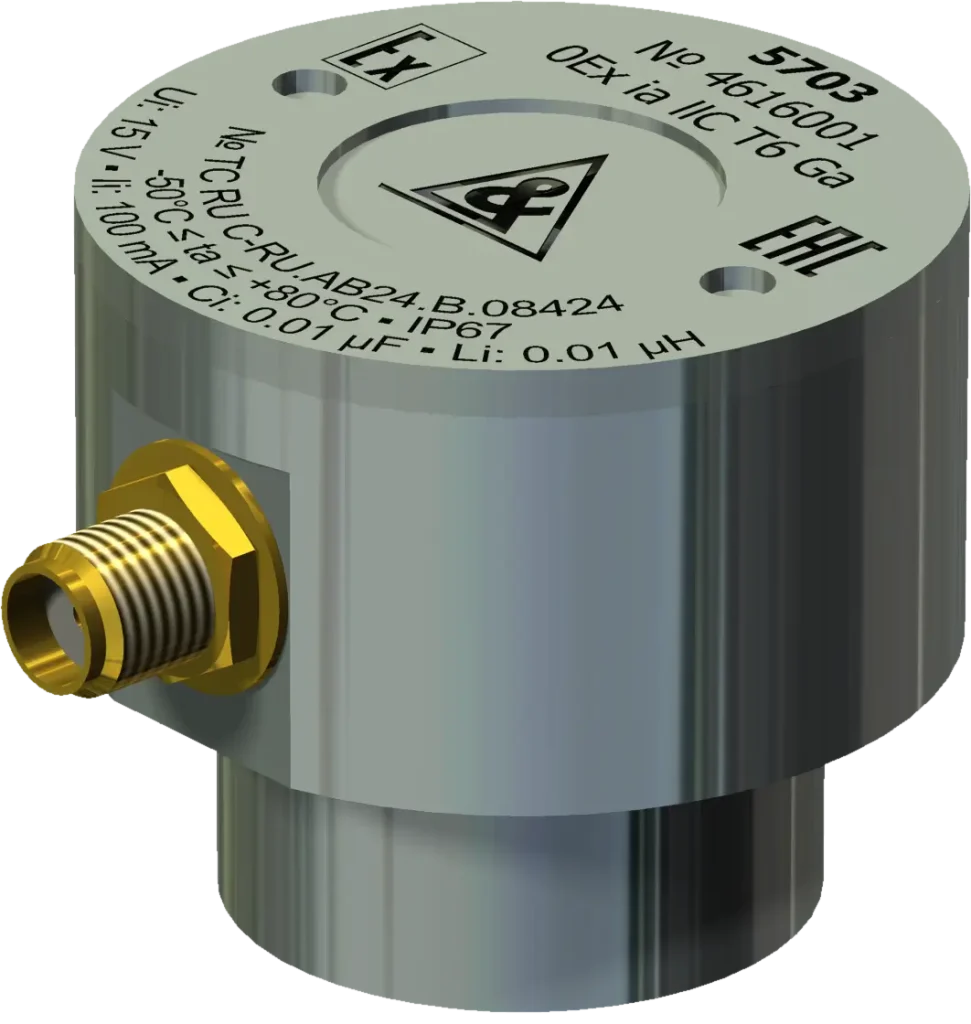
- Acoustic emission sensors for crack detection.
- Fiber-optic strain sensors for tracking deformation.
- Pressure and temperature sensors for thermal stress insights.
- Benchmarks installed on the upper neck of each drum for detecting the inclination of the coke drum.
Acoustic emission sensors are installed alongside the wave gauges to ensure their safety while operating near high temperatures. The system incorporates a sophisticated algorithm that filters all external and internal noises, providing refined diagnostic data for accurate analysis.
All data flowed to a centralized diagnostic station, where a custom-configured physics-based AI, tailored to coke drum degradation rules, processed the information. Coupled with advanced user-friendly software adapted to the unit’s operating conditions, the system delivered instant, location-specific, and actionable maintenance prescriptions—automatically prioritizing risk zones on the digital twin interface.
Explore All The COMPACS® System’s Solutions
Discover how real-time monitoring with AI-prescriptions can transform your approach to equipment maintenance.
What the System Revealed:
Hidden Cladding Failures and Process Hazards
Within weeks of deployment, the COMPACS® system identified:
Degradation from the Coke Drum Fast Cooling
- During the acoustic emission testing, linear strain and temperature growth rates consistently exceeded safe thresholds during the water cooling stage.
- The system correlated this with a shortened lifespan of the coke drums.
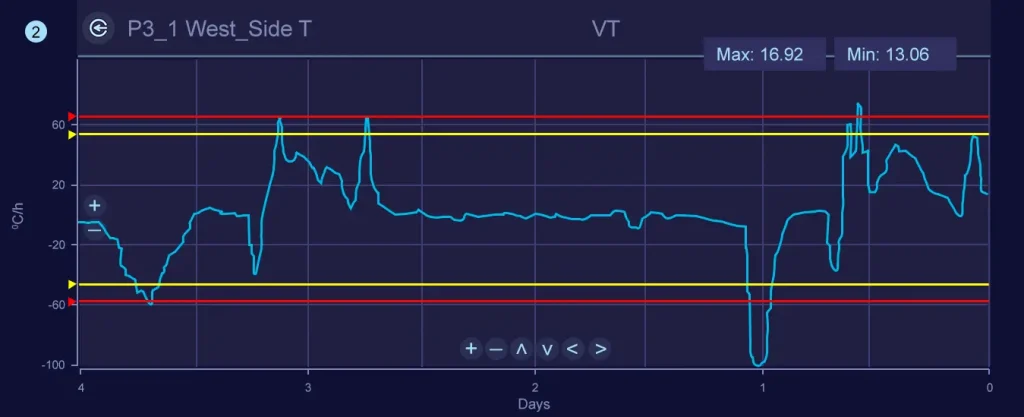
Undetected, this rapid cooling could have accelerated crack propagation, reduced equipment life expectancy, and significantly increased the likelihood of rupture and associated safety incidents.
Process Change Recommendation
The refinery revised its cooling strategy based on the system’s data and implemented a three-stage coke drum cooling process:
- Stage 1: Water vapor cooling.
- Stage 2: Hot water flushing.
- Stage 3: Cold water injection.
Before any action was taken, AE-impulse energy exceeded 2.7 mV2:

After the cooling procedure was changed, it didn’t exceed 1.3 mV2:
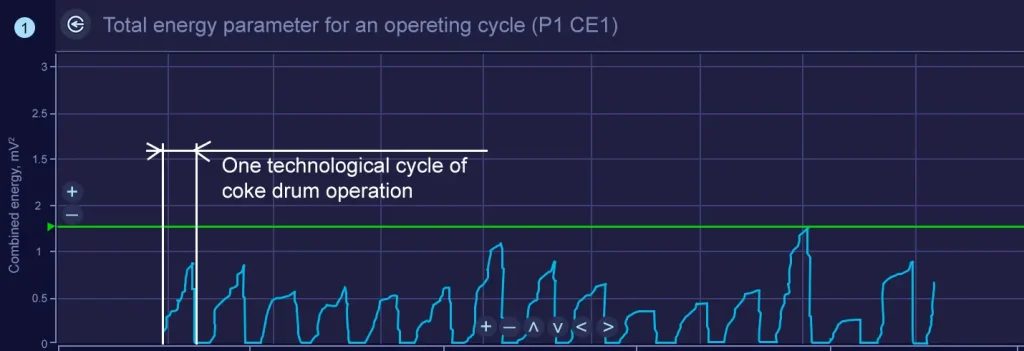
Result: AE pulse energy dropped by 52%, dramatically reducing the stress on coke drum internals.
A Critical Cladding Separation
- Acoustic emission activity in Sector AE25 exceeded Class 4 levels.
- The system issued an alert: “Catastrophic AE Energy (Class 4) – Lower Mode / Inspect,” and provided a precise location of the acoustic emission source.
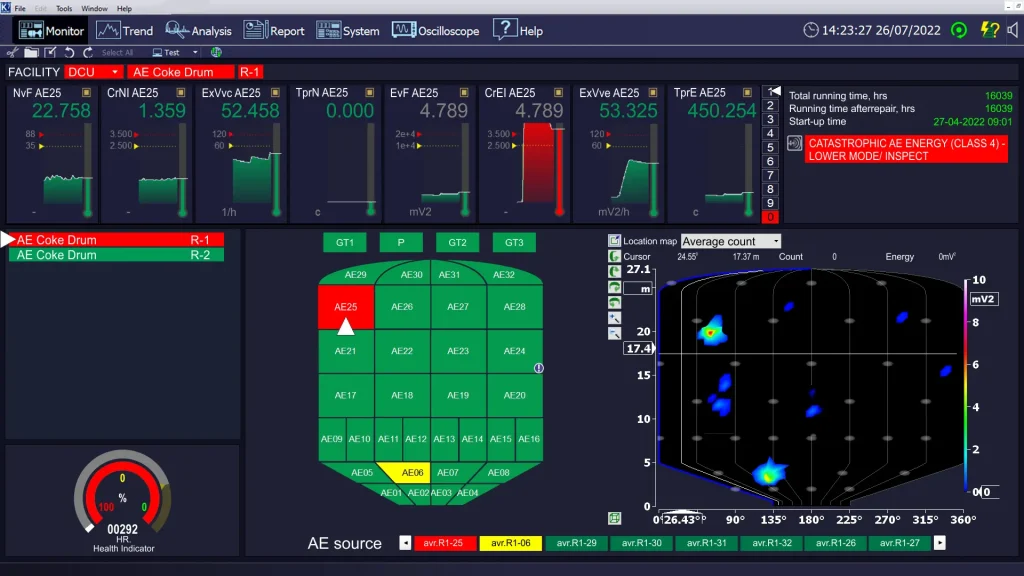
The top graph shows the acoustic emission during the coking process in the coking reactor. Each peak on the graph corresponds to a coking cycle, where spikes in acoustic activity are observed, indicating changes within the reactor. Starting in June 2018, the amplitude of these peaks has grown over time. It exceeded thresholds with several particularly high values in August, suggesting intense processes or possible damage.
The bottom graph displays the accumulated acoustic emission energy over the same period. Initially, the level of accumulated emission grows slowly, but the more acoustic emission energy exceeds thresholds, the sharper the increase of the accumulated energy. This sharp rise towards the end of the observation period indicates significant changes within the drum, as has been known later, related to the detachment of the inner cladding layer.

The coking drum was shut down for planned maintenance, and the maintenance team revealed an inner cladding layer detachment of approximately 3m2 at the very particular sector, which the real-time diagnostic COMPACS® system pointed out on the 2-D digital twin’s map. Thanks to the real-time equipment monitoring, timely maintenance was fulfilled, preventing significant consequences such as fire or explosion.
If the cladding detachment had gone unnoticed, it could have led to internal fires, pressure surges, structural failure of the coke drum, and, in worst-case scenarios, injury to personnel or full unit shutdown.
Results: Tangible Benefits for Operations and Maintenance
| Before the COMPACS® system | With the COMPACS® system | |
|---|---|---|
| Unplanned Shutdowns | 3 per year | 0 in 3 years |
| AE Event Rate | 2.7 mV² | 1.3 mV² |
| Internal Inspection Frequency | Quarterly | Annually |
| Maintenance Cost Reduction | – | Over $1.7M saved in 2014 alone |
Additional Benefits
Increased operator confidence through real-time alerts.
Improved safety compliance with API 934-C and ASME PCC-3.
24/7 health visibility of each drum on a digital twin interface.
Let’s Talk: Book a Meeting Today
Discover how real-time monitoring with AI-prescriptions can increase uptime and reduce maintenance costs.
Expert Insights: Best Practices for Coke Drum Monitoring
Based on interviews with refinery reliability managers and the COMPACS® system engineers, here are their top recommendations for reliable coker unit operations:
Start with Process Mapping
Understand the thermodynamic behavior of your coking unit under different modes. Tag all heating, coking, and cooling cycle stages in your historian. Use that to correlate acoustic emission activity and stress response.
Use Gradual Transition Protocols
Always design temperature and pressure ramps in multiple stages. Avoid single-stage rapid cooling that introduces high mechanical stress.
Visualize the Entire Unit
Implement a facility-wide digital twin that aggregates acoustic, thermal, and deformation data. This will help isolate “bad actors” and identify systemic risks.
Train for Real-Time Response
Ensure operators are trained to use the software, recognize prescriptions, and initiate proactive interventions based on system alerts.
Why This Case Matters for GCC Operators
Delayed coker units are widespread across Saudi Arabia, UAE, Kuwait, Qatar and Oman, yet very few operate with true real-time diagnostics. As the region pushes toward higher throughput and tighter HSE mandates, digital reliability isn’t optional—it’s a competitive advantage.
The real-time diagnostic COMPACS® system currently has over 900 installations worldwide. It has proven success in high-pressure, high-risk facilities. Its AI is built on 30+ years of data from refineries and petrochemical plants.
Want to prevent coke drum failures before they happen? Contact our specialists to schedule a live demo of the COMPACS® system for your plant.
Ready to See It in Action?
Discover how the COMPACS® system can transform your coke drum operations. Book a meeting to get your questions answered and explore practical implementation steps for your facility.
Explore Our Case Studies

Asset Reliability Management Based On Digital Technologies & AI
03/13/2024
Industrial safety is vital in ensuring the profitability of oil-refining and petrochemical industries. A high level of industrial safety in...
Read More
Case Study: Preventing Cavitation Damage
03/07/2025
The Hidden Threat: Cavitation in Petrochemical Plants Every petrochemical plant faces the invisible threat of cavitation, a destructive force capable...
Read More
Pump Monitoring Case - The COMPACS System Resolves Critical Failures
11/20/2024
Industrial pumps are vital for operations in industries like oil and gas, where equipment reliability and efficiency are non-negotiable. Unplanned...
Read More