Elimination Of Sudden Equipment Failures
Our digital technology allows you to solve the root problem and completely eliminate sudden failures. You can achieve this by implementing a real-time equipment health monitoring system in an entire processing facility
This curve represents the dependency between costs and losses by timing of fault detection. The later a defect is identified, the more significant the consequences and expenses are. Equipment undergoes three degradation stages during operation: non-linear wear, exponential wear, and a critical wear stage. To avoid not only failures but even redundant maintenance, we must identify defects in the non-linear wear stage. During this initial period, destructive forces only begin to degrade the equipment. Armed with this knowledge, an operator doesn’t need to be an expert in signal analysis. The equipment health monitoring system will let him know how and when to react. They don’t need to wait unless the defect leads to a breakdown. If operators identify and eliminate these destructive forces at such an early stage, safe and reliable operation becomes a reality

SROMM – Technology of Safe and Resource-saving Operation and Maintenance of Machinery. This approach ensures safe and reliable petroleum refining by utilizing timely unbiased information about machinery health, personnel involvement in reliability, and overall effectiveness of asset management at the facility
SROMM – Technology Diagram
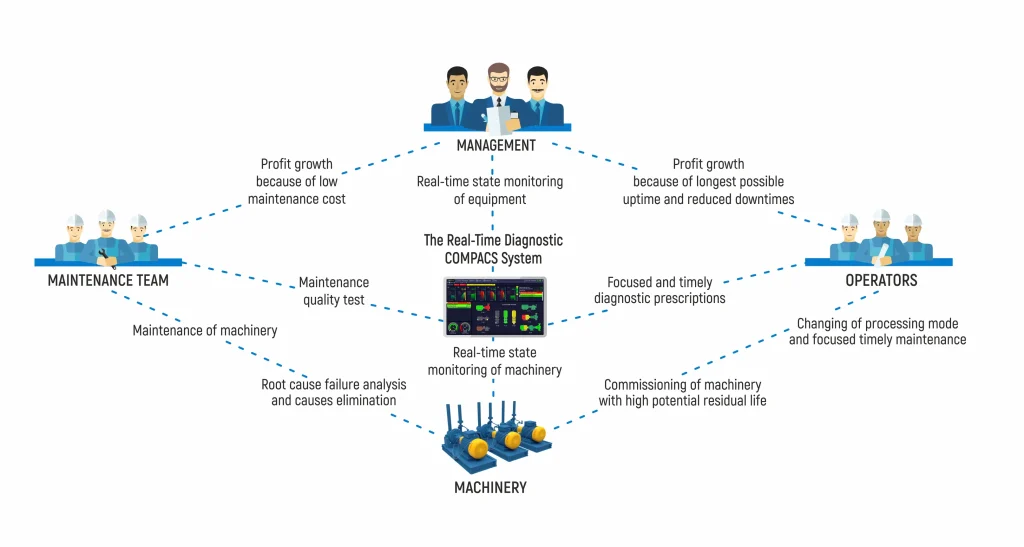
Three Information Loops Of The SROMM – Technology
The first loop is on the lower right. Operators should play a crucial role in the reliability of a facility because they are at the facility 24/7; so, they are the only people in the entire facility who can prevent deterioration and an emergency. That’s why we promote the operators’ driven reliability approach. When the system’s prescriptions are received, the operators need to take urgent actions to improve the equipment health and reliability. They can do it by themselves, call the maintenance department, or schedule contractors
The second Information Loop passes the information to the maintenance team. Due to being connected to the system, the maintenance team can perform even a very complex repair in very limited timeframes. Also, the maintenance team can schedule repairs based on the condition of the machinery
The third and final loop: Managers receive unbiased information about the machinery health, the operator’s involvement in reliability, and the maintenance quality and timeliness. Such an approach to personnel coordination ensures safe resource-saving operation of machinery, since it can guarantee that all three stages of the reliability management are completed
 Physics Based AI
The real-time diagnostic COMPACS® system identifies almost all defects in rotating and fixed equipment at their emergence with an accuracy of 97 – 99%
Physics Based AI
The real-time diagnostic COMPACS® system identifies almost all defects in rotating and fixed equipment at their emergence with an accuracy of 97 – 99%
 Crucial Components Of The COMPACS® System
The real-time diagnostic COMPACS® system comprises own cutting-edge hardware, physics-based artificial intelligence, and user-friendly software
Crucial Components Of The COMPACS® System
The real-time diagnostic COMPACS® system comprises own cutting-edge hardware, physics-based artificial intelligence, and user-friendly software
 True Safety And Reliability
Affordable price, tailor-made engineering, and turn-key installation allow to equip with the system each and every piece of rotating equipment and all critical static equipment at the facility
True Safety And Reliability
Affordable price, tailor-made engineering, and turn-key installation allow to equip with the system each and every piece of rotating equipment and all critical static equipment at the facility
 No More Sudden Failures
Armed with unbiased, accurate and timely information operators and maintenance team
jointly eliminates sudden equipment failures, and provide safe resource-saving operation and maintenance of machinery
No More Sudden Failures
Armed with unbiased, accurate and timely information operators and maintenance team
jointly eliminates sudden equipment failures, and provide safe resource-saving operation and maintenance of machinery
 Three Steps To The Paramount Reliability
Substantial contribution to reliability from operators and high quality, timeliness, and responsiveness of the maintenance team allows to eliminate root-causes of equipment failures and bottlenecks that limit the facility’s operation.
Three Steps To The Paramount Reliability
Substantial contribution to reliability from operators and high quality, timeliness, and responsiveness of the maintenance team allows to eliminate root-causes of equipment failures and bottlenecks that limit the facility’s operation.