Three Steps To The Paramount Industrial Reliability
With The Real-Time Diagnostic COMPACS® System
Industrial Reliability
To switch to the digital reliability paradigm, the diagnostic network of a company must integrate data from all monitoring systems. That will allow for the creation of a single transparent environment for real-time reliability management. The digital reliability platform is based on the COMPACS® system. The system transforms complex real-time data into objective and timely information required for decision-making. The real-time equipment monitoring with residual lifespan forecasting allows for unbiased assessment of operators’ commitment to reliability and maintenance quality. Such an approach positively changes the working environment. The new digital reliability paradigm enables the refiners to stop the constant arguing between the service personnel about who’s responsible for the machine’s failure. It allows for conscious cooperation between all departments towards the highest availability and most extended uptime.
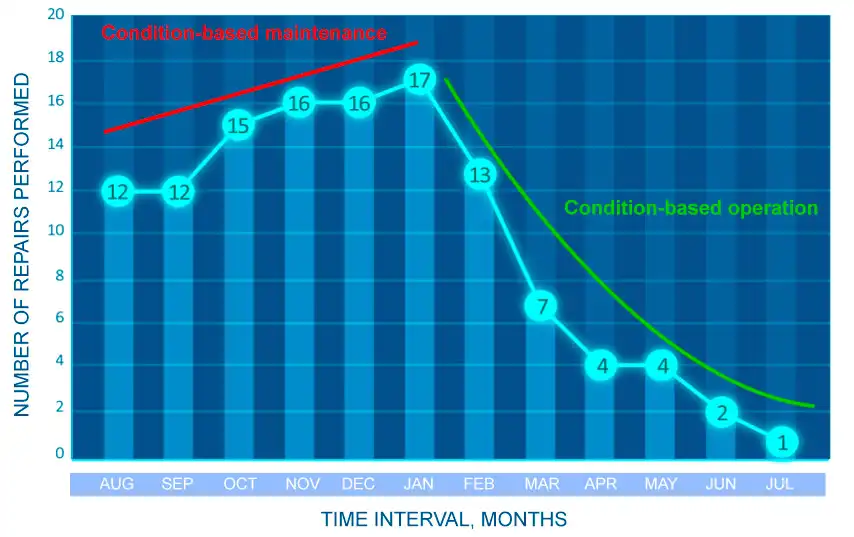
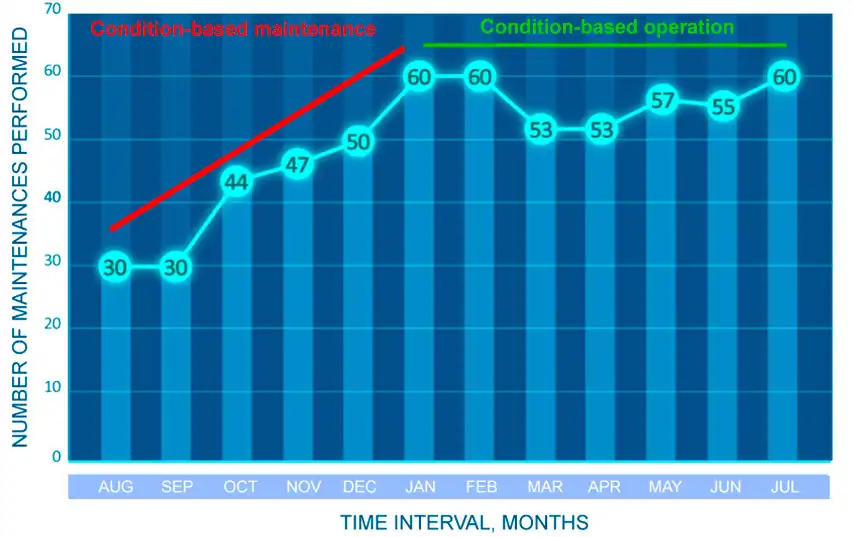
The first step in the transition towards digital reliability is for personnel. Maintenance and reliability teams should bring the current state of the machinery to a good one. The COMPACS® system allows management, operators, and maintenance teams to be on the same page. With the system, they can all see the same unbiased picture of the real-time state of equipment. It increases the amount of proactive maintenance cases and reduces the number of repairs while making them less complex. The reliability paradigm change is shown on the two diagrams. On the left are monthly machinery repairs in workshops. On the right are monthly quantities of the process mode alterations that positively affected the equipment state. The maintenance team completes 15 -17 monthly repairs in the year’s first half. During the same period, the operators, using the system’s prescriptions, increase the number of the process mode adjustments from 30 to 60 per month and hold them at this level. After the process mode alterations and maintenance of running equipment became regular, the number of repairs decreased from 17 in January to 1 in July, considerably improving the reliability of rotating equipment at the refinery unit.
1
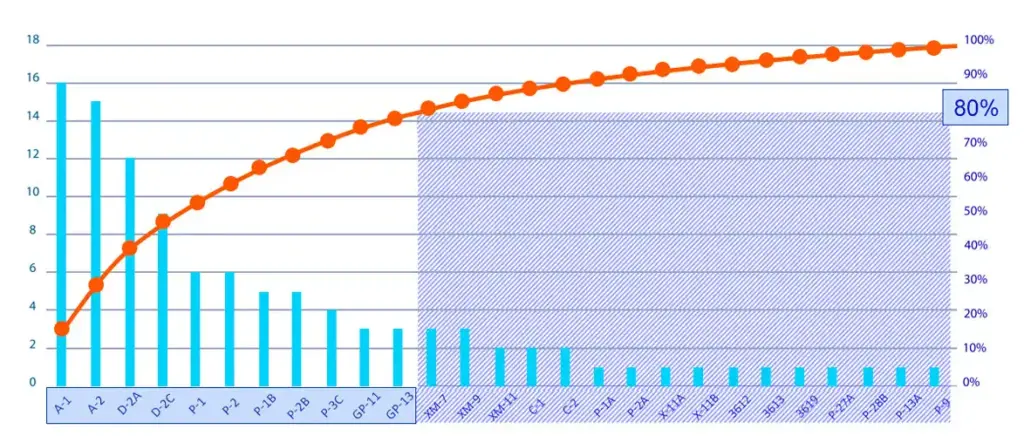
The next step to improving reliability is eliminating root causes of failures. The diagram shows that 11 machines of the 200+ machines of the FCC Unit generate 80% of all maintenance orders. If the root causes of those bad actors were eliminated, the equipment’s reliability and availability would increase considerably.
2
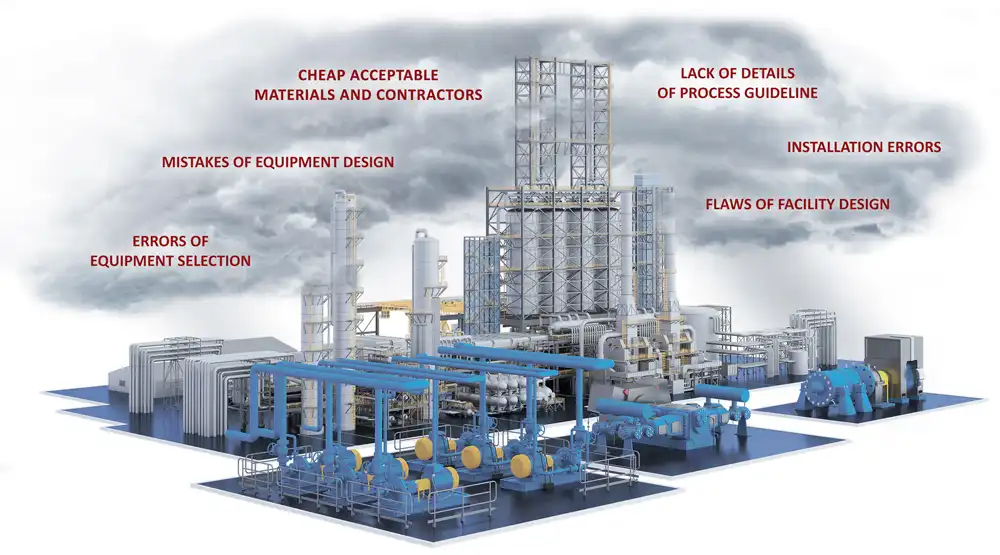
The third and most important step towards increasing reliability is eliminating bottlenecks in the production facility. Liquidating the physical obstacles that limit the facility’s uptime allows rising availability from the current 80-85% to the technically available 99% and ensures considerable growth of the Unit’s margin due to boosting the annual production rate.
3
 Physics Based AI
The real-time diagnostic COMPACS® system identifies almost all defects in rotating and fixed equipment at their emergence with an accuracy of 97 – 99%
Physics Based AI
The real-time diagnostic COMPACS® system identifies almost all defects in rotating and fixed equipment at their emergence with an accuracy of 97 – 99%
 Crucial Components Of The COMPACS® System
The real-time diagnostic COMPACS® system comprises own cutting-edge hardware, physics-based artificial intelligence, and user-friendly software
Crucial Components Of The COMPACS® System
The real-time diagnostic COMPACS® system comprises own cutting-edge hardware, physics-based artificial intelligence, and user-friendly software
 True Safety And Reliability
Affordable price, tailor-made engineering, and turn-key installation allow to equip with the system each and every piece of rotating equipment and all critical static equipment at the facility
True Safety And Reliability
Affordable price, tailor-made engineering, and turn-key installation allow to equip with the system each and every piece of rotating equipment and all critical static equipment at the facility
 No More Sudden Failures
Armed with unbiased, accurate and timely information operators and maintenance team
jointly eliminates sudden equipment failures, and provide safe resource-saving operation and maintenance of machinery
No More Sudden Failures
Armed with unbiased, accurate and timely information operators and maintenance team
jointly eliminates sudden equipment failures, and provide safe resource-saving operation and maintenance of machinery
 Three Steps To The Paramount Reliability
Substantial contribution to reliability from operators and high quality, timeliness, and responsiveness of the maintenance team allows to eliminate root-causes of equipment failures and bottlenecks that limit the facility’s operation.
Three Steps To The Paramount Reliability
Substantial contribution to reliability from operators and high quality, timeliness, and responsiveness of the maintenance team allows to eliminate root-causes of equipment failures and bottlenecks that limit the facility’s operation.